So, ok. Sensory overload in the third-world of Sierra Leone, at least for this neophyte, first-world interloper, is akin to lighting a cigar by sticking your head in a blast furnace. Pretty overwhelming. What follows are some off-the-top-of-the-land-rover impressions. I'll be posting more, so come back. In the meantime, in no particular order, here they are:
You sleep with earplugs because the dogs bark all night long.
Sometimes the earplugs don’t even help. They start about 10 p.m., about 15 to 30 minutes before the generator shuts off for the night (and the lights go out).

Some nights are quieter than others, but they bark every night. It’s like turning on a switch. We didn’t hear a dog bark all day long. But at night, we didn’t hear them not bark. And these dogs are ugly. Take a look at this one. He is lying in front of the parsonage in Makeni where we housed ourselves. He growled as I approached to take this photo. I suppose that might be expected, as I am a stranger. But there was something odd about the dogs in Makeni. I never saw anyone pet them and I never saw them present themselves to humans the way domesticated dogs do. They were always alone with no master. I wonder if they were actually wild (or unowned) and just living among humans as a means of survival.
Roosters wake you every morning.The roosters are in cahoots with the dogs. When the dogs stop barking, the roosters start crowing, removing any chance of sleep in the dark.
House spiders are as big as your hand.
Oh, yeah! This is definitely not an exag-geration. Take a look at this guy in the corner near the ceiling in the hallway. Ultra huge. Which added a certain level of anxiety when nature called in the middle of the night and you found yourself navigating down the hallway with your flashlight. I mean, intellectually you knew that the gargantuan arachnid from Hades really couldn’t tear off your leg, but still, you did feel the need to shine your light into the corners and the urge to hurry along. (Isn't that just the coolest picture!)
It is hot and humid, probably into the 90s every day.Sierra Leone is seven degrees north of the equator (560 miles). It is a tropical country. Two seasons divide the year: rainy, from May through October, and dry, from November through April. While we didn’t have a thermometer, I’d say that daytime temperatures reached the 90s most days during our stay, and nighttime temps remained in the mid- to low 80s.

I would sleep without covers in just a pair of gym shorts. Next to me about two feet away was a small, portable, battery-operated fan. We all had them. They helped keep us cool. After dressing in the morning, I would pretty much be wet from sweat in 90 minutes or so. One morning, a modest 45-minute stroll through the surrounding residential area in Makeni left me practically soaked. That’s why I wore my yellow bandana. Cool, right? (I know, I know. Please—no fan mail.)
Good health care is rare and drastically needed; one in eight women die in childbirth.This is a sad fact that takes some effort to comprehend. Most Americans can walk into a drug store and get over-the-counter medications that are scarce in Sierra Leone—ibuprofen, antibiotics, and other common drugs. Most Americans, if they really need to, can find a doctor to see them in a couple of hours, or at least, a day. That would be a luxury in Sierra Leone. In this chronically deprived country, trained medical personnel and supplies are scarce, and so is access to them. This is the issue addressed by The Lance and Julie Burma Foundation’s effort to establish a clinic in the remote village of Manonkoh (pronounced maa-no’-ko). Pregnant women often go into the bush to have their babies—often alone, sometimes with a local midwife. It’s a real roll of the dice. I’ll talk more about this in a subsequent article.
Median age is 17 (half of the country's population is under age 17).Pretty amazing. Am not positive about the reason for this—it may partially be the result of the civil war (1991-2001), or it may be because of the standard of living. Life expectancy at birth is 40 years overall, 38 for men, 42 for women. The infant mortality rate is 160 deaths per 1,000 live births (in the U.S. it is six per 1,000).
Women are the material handlers—they carry everything, mostly on their heads.Now this is one of the most amazing phenomenons I have ever seen. Within a community, women move all kinds of items from one place to another—on their heads.
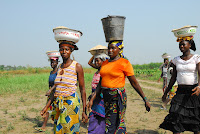
They will carry a five-gallon container of cooking oil or water (water weighs 8.35 pounds/gallon), open pans of water (and not spill), sand, firewood—you name it. Street vendors carry their merchandise on their heads. One of the most unusual occurrences of this was in Freetown where a woman was selling charcoal. Charcoal is sold in baskets about 12 to 14 inches in diameter. The woman I saw had seven of these heaping baskets of charcoal on her head. If she had raised her arms, she could not have reached the top of the stack. I have absolutely no idea how she could remove one of the baskets without tipping over the entire stack. When workmen were repairing the concrete around the Manonkoh school, the women in this photo moved sand from the local sand pile to the school where it was mixed into concrete.

And take a look at this woman coming through the bush from collecting firewood. What you cannot see from this angle is her daughter following her with a basket on her (the daughter’s) head as well—and—the mother has her baby on her back. They walk quite naturally, stop and converse with each other—much as we would do with a backpack hanging on our shoulder. I mean, we’ve all seen pictures of this, but to see it functioning in daily life makes me appreciate their ingenuity. Why don’t we do that? Machines, I suppose. We invent machines.
The machete is the universal work tool.Oh, we’ve all seen movies of or read stories about the Mau Mau uprising in Kenya, or seen or heard other gruesome accounts about people being killed or maimed with machetes.

But truth is, this common tool is ubiquitous and has many uses. It is the Oddjob (remember Goldfinger?) of Sierra Leonean tools. The machete has different shapes depending where in the world you live. Generally, it is about the length of your arm and has a blade 24 to 28 inches long. Some are fat, some thin, some straight, some curved. The machetes in Sierra Leone have blades that widen at the tip and curve forward, like the one used in the accompanying photo. This worker is helping to construct a bamboo fence around a local well. He is trimming the bamboo to size. (Incidentally—take a look at that bamboo. Its diameter is about four inches—kind of like PVC pipe.

And also incidentally, women cut it down and carried it to the site. The stalks are 15 to 20 feet long! Yikes!) One of the well workers used a machete to loosen ground while digging the fence hole around the well. Machetes are used to cut through the bush or to cut sugar cane, and even in the house to cut large foodstuffs. When we visited Yonibana, a town about two-and-a-half hours away from our base in Makeni, the people we visited presented us with coconuts and proceeded to open them with machetes. And, when Abu, our driver, locked his keys in the cruiser, he promptly found a machete and used it to remove the rubber window lining in his effort to get into the car. (Yes—he finally got in and recovered his keys.)
Average income is $400 per year.This is the figure we talked about when we were in Sierra Leone. However, in trying to verify it from other sources, I am discovering that estimates vary. One 2003 World Bank estimate put the average annual income at $530, another from the CIA Factbook put it at $800. A December 8, 2008, article on Economist.com says 70% of the population gets along on 70 cents a day, or $255 a year. Not sure it really matters, because the point is that it isn’t very much money. While many necessities and foods may cost less there (bread costs $.65 a loaf; you can buy 10 eggs for $1.30), $33 to $66 a month can’t go very far. This is one of the facts that confounded me: for all of the selling that was going on in the country, I kept wondering who was doing the buying.
The cost of sending a child to school for one year is $45.Not much, is it? The school year is divided into three semesters. Students pay $15 per session. That does not include textbooks. Most of the time, the teacher writes the lesson on the blackboard and the children copy it into their notebooks. As the children get older (junior high, I’m guessing), the cost per school session rises, mostly because of required materials. I’m not sure what that cost is, but I couldn’t imagine it to be much more that the basic $45. This is troubling for me. I spend $75 twice a month on cigars.
Running water and electricity are a luxury.True. Electricity used to be there, but was destroyed during the civil war.

(Makeni was the rebel base during the civil war.) The plumbing remains in the buildings, but the water supply is lost. On a trip to Lunsar to conduct a de-worming program for the school children there, I watched an Italian work crew pulling new electrical transmission lines through the towers. (See the photo.) The line of towers extends right to Makeni, where we stayed, so it is only a matter of time before the wires find their way inland. The government is serious about rebuilding infrastructure because it is needed to rebuild the economy and develop a tourist industry. We were supposed to have running water at our hotel in Freetown, but it was sporadic at best. The hotel had an annex, which did not have water at all. The main building did, but just barely. In Makeni, there was none available to us or anyone we knew, save, perhaps, guests at the fanciest new hotel in town.
Bathing involves pouring water at ambient temperature over your body.Most of us have probably done this at one time or another in our lives. Probably camping. There is always that initial shock of the cold water and that first, quick deep breath. What saved us was that the ambient temperature was near 90 most afternoons. We would return from Manonkoh around 5 or 6 p.m. and start vying for time on the computer, phone, or for the shower. There was a separate shower room, perhaps five-feet square. Original plumbing was still there. A pipe extended from the wall at about seven feet. The shower head was gone, of course, but it didn’t matter, because so was the water. One member of our group cleverly thought to bring a camp shower, which is a heavy rubber bag that holds five gallons of water. It has a handle, which was quite useful and allowed us to hang it from the original water pipe. Regrettably, at least for me (because I am a giant), the hose and valve at the bottom of the bag was about waist high—so I had to be creative in finding a way to cover my body with water, which usually involved me getting lower somehow as the bag was as high as it was going to go. Truth is, however, that the water was actually at a rather refreshing temperature, and several members of the group commented about how good it felt. (Amazing what you can become accustomed to, isn’t it!)
Food is pretty good, though some of it can be quite exotic (we didn’t go there).Bush meat was off limits. No monkey! No swamp rat! We did eat meat in some of the sauces that we poured over our rice. We could recognize the chicken. We didn’t ask about the other. The cooks prepared one sauce that had both meat and fish in it. Almost daily, the evening meal included rice with some type of sauce over it. Other foods included fresh fruits—plantains, mango, oranges, bananas—roots, French fries, and once in a while, fresh coconut (which is actually rather bland tasting). For breakfast, we might have some kind of porridge, which was prepared as a kind of soupy oatmeal. We were also served a type of fried egg with various ingredients in it—we called it an omelet—that was rather tasty, if a bit greasy. And, of course, the favorite fallback food, peanut butter (brought from the U.S.). For lunch, we often had tuna or chicken salad sandwiches, made from canned meats. For those of us who are coffee addicts, we had to settle for instant coffee—ouch!

We did stay away from the exotic stuff, though. As you can see in the ac-companying photos, people do kill and eat moneys and swamp rats (also known as grass cutters). These photos were taken on the main highway between Makeni and Freetown on the trip home. All along the highway, people stand and sell whatever they can find. As in the photo above, monkeys were hung on posts for passersby to inspect. Our driver, Abu, stopped the cruiser to bargain with the young man who had the swamp rat.

We were traveling 65 miles an hour or so when Abu spotted the young road merchant holding the grass cutter above his head. By the time he had stopped the cruiser, the young man was running after us to catch up. But, alas, the deal did not go through: the young man wanted 22,000 leones (about $7.50) for the grass cutter, but Abu was only willing to pay 15,000 ($5.00). So we drove on. Abu explained to us that he has a Nigerian friend who considers the grass cutter his favorite meat.
During our trip home (which would eventually take four hours), we stopped for a stretch break. One member of our group suffers from motion sickness. We pulled off the road at a spot where we could drive into an open area and turn the cruiser around. Of course, the roadside vendors came over to see us. They were selling gas and various food items, not the least of which was some monkey meat. It looked as if it were barbequed. I try to imagine who is buying and eating this meat. And I try to be cognizant of the fact that what may be an appetite suppressant for me may be particularly appetizing for someone else. But for whomever that is, we are light years apart culturally.
In a way, the trip back to Freetown is a microcosm of the struggle for survival in Sierra Leone. Take what you have, what you can make or gather or catch or kill, and take it to the road. Perhaps a passing traveler will buy it. Perhaps you can get money to buy the things you need.
(I’ve got more initial impressions, but I had to stop here and get this posted. So come back soon.)
 We are lucky this time in San Francisco; it's a destination for us, but we know people who live here and crawl the streets looking for fabulous hole-in-the-wall restaurants and entertainment venues. After reconnecting with my niece, Jeanmarie, earlier this year, we discovered that she and her husband not only work in San Francisco, but they also avail themselves of the many culinary opportunities that this international city offers. One of the places she recommended was Burma Superstar. Here is what she said about it and why we decided to give it a try: "Amazing Burmese food . . . best in town. You stand on the sidewalk to get in during dinner. Honestly, go for lunch . . . same menu, but not so much of a wait. This s a bit of a dive restaurant, but probably one of the hottest places in town. It's a haul from Downtown, but an adventure. Neighborhood staple." (By the way--that's Char in the photo in front of the restaurant.)