Sunday, January 25, 2009

Rock Solid Appliances (or Solid Rock Appliances)

In Sierra Leone, a washing machine is a rock. This was evident everywhere. Women would wash clothes in basins or big pans or stand in pools along a roadside or in the river and soak clothes. Then they would beat them on a rock.

We took a tour of an orphanage in Makeni, the Children's Rescue Operation Project. We walked through the house, out the back, and around the side. As we passed it, Abu, our driver, pointed and said casually, “That is the washing rock.” You see it in the center of the photo of the house with a small tree in front of it, and again in the close up photo.

It's hard on the clothes, to be sure—washing them on a rock. We were warned prior to embarking on our journey that we should be prepared to have our freshly washed clothes returned with tiny holes, a by-product of using the manually operated rock washer. Actually, this never happened while we were there—that our clothes came back with holes. Rather, they came back smelling of smoke—as they would if I had been near a campfire. Our clothes were washed daily and they must have been hung to dry near the cooking fire. They always smelled of smoke. Sometimes they were still damp. We had to put them on a drying rack to let them finish drying.

I can remember my mother using a ringer-style washing machine. She would take the freshly washed clothes out to the back yard and hang them on the clothesline. Even in winter. Our clothes would freeze then, but they would dry. That was a lot of work. What must it be like for the women of Sierra Leon who have only a rock to wash clothes and the brush or the roadside or the ground to lay them on to dry?

Big Joe and Little Joe

One of the more interesting and fun experiences during our time in Sierra Leone was our interaction with the children. As soon as we got out of the truck, the children surrounded us. They would take our hands and tell us their names. And after about a half dozen kids told you their names, they would start to ask you to repeat their names. So, the deal was, we memorize a whole bunch of names, but all they need to do is remember ours. Very challenging. But, for the most part, they were delightful. This actually happened to us in two communities: Makeni, where we stayed, and Manonkoh, where we spent most of our project time.

While we were out-side, the children were with us con-stantly. And as you might expect, certain kids show up all the time. Their regular presence gives you a chance to get to know them and to become friends. I think each member of the group formed friendships with one or more of the children. Certainly I developed somewhat of a relationship with the little guy I'm holding in the photos. I met him on the first day I went to Manonkoh. His name is Joe, and he learned that my name was also Joe. And so, from that first day until the last day in Manonkoh, he was at my side whenever I was there. He was attached by an invisible elastic band. When I would get out of the truck, he would suddenly be there. And if I walked off or moved around to take a picture, he would soon appear again at my side. He rarely smiled, and we didn't converse much. But he did lobby me from time to time to take a picture of him and a friend. He is the size of a two-year-old, but I suspect he was perhaps three or four. He sort of took possession of me. When other children came up to me and took my other hand, he would chase them away. I made an effort to stop him from doing that, but he was rather persistent. I actually had to physically restrict him from hitting some of the other kids. (Just as an aside, the children were very rough and tough on each other. In many ways, they are no different than children anywhere.)

You can see that I wore a yellow bandanna while I was there. One day, late in our stay, I took out a bandanna and tied it on Little Joe's head. That raised quite a stir. Several children asked me for a bandanna, and I did finally give away a few. After I gave Little Joe the bandanna, he disappeared for a while, only to show up a few minutes with a woman who must have been his mother. He held up a bag to me. In it was two guava fruits. It was his gift to me.

In addition to telling us their names and requir-ing us to remember them, the children also con-stantly asked us to "snap" them. Snapping, of course, refers to a snapshot--a photo. Their method of communicating this was to come up to us, hold their tiny little fists over their eyes as if to simulate the picture-taking process, and then call, "Porto, porto, snap me, snap me."

Now, porto translates as white man. Actually, the term is "el porto" and hails from the first white visitors, the Portuguese. But the "el" often got dropped, or would be pronounced more like, "Aporto, aporto." You get the idea.

The process of taking a snap is to make the photograph of the child, and sometimes his or her friend, then turn the camera around to show them the viewing screen so that they could see themselves. This usually resulted in a lot of oohs and ahs.

Now, there was a risk to snapping a child. The crowd around your legs might only be four or five kids at any one time. But as soon as you took the first picture of the first child, the crowd would quickly grow to 10 or 15, and often more. The more photos I took, the more requests I got. This was the same for everyone in the party. The children just swarmed around us. They pushed and shoved each other to get in front of the lens. They never tired it.

Sunday, January 11, 2009

Sierra Leone--Initial Impressions

So, ok. Sensory overload in the third-world of Sierra Leone, at least for this neophyte, first-world interloper, is akin to lighting a cigar by sticking your head in a blast furnace. Pretty overwhelming. What follows are some off-the-top-of-the-land-rover impressions. I'll be posting more, so come back. In the meantime, in no particular order, here they are:

You sleep with earplugs because the dogs bark all night long.
Sometimes the earplugs don’t even help. They start about 10 p.m., about 15 to 30 minutes before the generator shuts off for the night (and the lights go out). Some nights are quieter than others, but they bark every night. It’s like turning on a switch. We didn’t hear a dog bark all day long. But at night, we didn’t hear them not bark. And these dogs are ugly. Take a look at this one. He is lying in front of the parsonage in Makeni where we housed ourselves. He growled as I approached to take this photo. I suppose that might be expected, as I am a stranger. But there was something odd about the dogs in Makeni. I never saw anyone pet them and I never saw them present themselves to humans the way domesticated dogs do. They were always alone with no master. I wonder if they were actually wild (or unowned) and just living among humans as a means of survival.

Roosters wake you every morning.
The roosters are in cahoots with the dogs. When the dogs stop barking, the roosters start crowing, removing any chance of sleep in the dark.

House spiders are as big as your hand.
Oh, yeah! This is definitely not an exag-geration. Take a look at this guy in the corner near the ceiling in the hallway. Ultra huge. Which added a certain level of anxiety when nature called in the middle of the night and you found yourself navigating down the hallway with your flashlight. I mean, intellectually you knew that the gargantuan arachnid from Hades really couldn’t tear off your leg, but still, you did feel the need to shine your light into the corners and the urge to hurry along. (Isn't that just the coolest picture!)

It is hot and humid, probably into the 90s every day.
Sierra Leone is seven degrees north of the equator (560 miles). It is a tropical country. Two seasons divide the year: rainy, from May through October, and dry, from November through April. While we didn’t have a thermometer, I’d say that daytime temperatures reached the 90s most days during our stay, and nighttime temps remained in the mid- to low 80s. I would sleep without covers in just a pair of gym shorts. Next to me about two feet away was a small, portable, battery-operated fan. We all had them. They helped keep us cool. After dressing in the morning, I would pretty much be wet from sweat in 90 minutes or so. One morning, a modest 45-minute stroll through the surrounding residential area in Makeni left me practically soaked. That’s why I wore my yellow bandana. Cool, right? (I know, I know. Please—no fan mail.)

Good health care is rare and drastically needed; one in eight women die in childbirth.
This is a sad fact that takes some effort to comprehend. Most Americans can walk into a drug store and get over-the-counter medications that are scarce in Sierra Leone—ibuprofen, antibiotics, and other common drugs. Most Americans, if they really need to, can find a doctor to see them in a couple of hours, or at least, a day. That would be a luxury in Sierra Leone. In this chronically deprived country, trained medical personnel and supplies are scarce, and so is access to them. This is the issue addressed by The Lance and Julie Burma Foundation’s effort to establish a clinic in the remote village of Manonkoh (pronounced maa-no’-ko). Pregnant women often go into the bush to have their babies—often alone, sometimes with a local midwife. It’s a real roll of the dice. I’ll talk more about this in a subsequent article.

Median age is 17 (half of the country's population is under age 17).
Pretty amazing. Am not positive about the reason for this—it may partially be the result of the civil war (1991-2001), or it may be because of the standard of living. Life expectancy at birth is 40 years overall, 38 for men, 42 for women. The infant mortality rate is 160 deaths per 1,000 live births (in the U.S. it is six per 1,000).

Women are the material handlers—they carry everything, mostly on their heads.
Now this is one of the most amazing phenomenons I have ever seen. Within a community, women move all kinds of items from one place to another—on their heads.
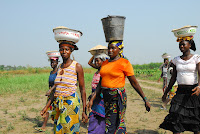
They will carry a five-gallon container of cooking oil or water (water weighs 8.35 pounds/gallon), open pans of water (and not spill), sand, firewood—you name it. Street vendors carry their merchandise on their heads. One of the most unusual occurrences of this was in Freetown where a woman was selling charcoal. Charcoal is sold in baskets about 12 to 14 inches in diameter. The woman I saw had seven of these heaping baskets of charcoal on her head. If she had raised her arms, she could not have reached the top of the stack. I have absolutely no idea how she could remove one of the baskets without tipping over the entire stack. When workmen were repairing the concrete around the Manonkoh school, the women in this photo moved sand from the local sand pile to the school where it was mixed into concrete. And take a look at this woman coming through the bush from collecting firewood. What you cannot see from this angle is her daughter following her with a basket on her (the daughter’s) head as well—and—the mother has her baby on her back. They walk quite naturally, stop and converse with each other—much as we would do with a backpack hanging on our shoulder. I mean, we’ve all seen pictures of this, but to see it functioning in daily life makes me appreciate their ingenuity. Why don’t we do that? Machines, I suppose. We invent machines.

The machete is the universal work tool.
Oh, we’ve all seen movies of or read stories about the Mau Mau uprising in Kenya, or seen or heard other gruesome accounts about people being killed or maimed with machetes. But truth is, this common tool is ubiquitous and has many uses. It is the Oddjob (remember Goldfinger?) of Sierra Leonean tools. The machete has different shapes depending where in the world you live. Generally, it is about the length of your arm and has a blade 24 to 28 inches long. Some are fat, some thin, some straight, some curved. The machetes in Sierra Leone have blades that widen at the tip and curve forward, like the one used in the accompanying photo. This worker is helping to construct a bamboo fence around a local well. He is trimming the bamboo to size. (Incidentally—take a look at that bamboo. Its diameter is about four inches—kind of like PVC pipe. And also incidentally, women cut it down and carried it to the site. The stalks are 15 to 20 feet long! Yikes!) One of the well workers used a machete to loosen ground while digging the fence hole around the well. Machetes are used to cut through the bush or to cut sugar cane, and even in the house to cut large foodstuffs. When we visited Yonibana, a town about two-and-a-half hours away from our base in Makeni, the people we visited presented us with coconuts and proceeded to open them with machetes. And, when Abu, our driver, locked his keys in the cruiser, he promptly found a machete and used it to remove the rubber window lining in his effort to get into the car. (Yes—he finally got in and recovered his keys.)

Average income is $400 per year.
This is the figure we talked about when we were in Sierra Leone. However, in trying to verify it from other sources, I am discovering that estimates vary. One 2003 World Bank estimate put the average annual income at $530, another from the CIA Factbook put it at $800. A December 8, 2008, article on Economist.com says 70% of the population gets along on 70 cents a day, or $255 a year. Not sure it really matters, because the point is that it isn’t very much money. While many necessities and foods may cost less there (bread costs $.65 a loaf; you can buy 10 eggs for $1.30), $33 to $66 a month can’t go very far. This is one of the facts that confounded me: for all of the selling that was going on in the country, I kept wondering who was doing the buying.

The cost of sending a child to school for one year is $45.
Not much, is it? The school year is divided into three semesters. Students pay $15 per session. That does not include textbooks. Most of the time, the teacher writes the lesson on the blackboard and the children copy it into their notebooks. As the children get older (junior high, I’m guessing), the cost per school session rises, mostly because of required materials. I’m not sure what that cost is, but I couldn’t imagine it to be much more that the basic $45. This is troubling for me. I spend $75 twice a month on cigars.

Running water and electricity are a luxury.
True. Electricity used to be there, but was destroyed during the civil war. (Makeni was the rebel base during the civil war.) The plumbing remains in the buildings, but the water supply is lost. On a trip to Lunsar to conduct a de-worming program for the school children there, I watched an Italian work crew pulling new electrical transmission lines through the towers. (See the photo.) The line of towers extends right to Makeni, where we stayed, so it is only a matter of time before the wires find their way inland. The government is serious about rebuilding infrastructure because it is needed to rebuild the economy and develop a tourist industry. We were supposed to have running water at our hotel in Freetown, but it was sporadic at best. The hotel had an annex, which did not have water at all. The main building did, but just barely. In Makeni, there was none available to us or anyone we knew, save, perhaps, guests at the fanciest new hotel in town.

Bathing involves pouring water at ambient temperature over your body.
Most of us have probably done this at one time or another in our lives. Probably camping. There is always that initial shock of the cold water and that first, quick deep breath. What saved us was that the ambient temperature was near 90 most afternoons. We would return from Manonkoh around 5 or 6 p.m. and start vying for time on the computer, phone, or for the shower. There was a separate shower room, perhaps five-feet square. Original plumbing was still there. A pipe extended from the wall at about seven feet. The shower head was gone, of course, but it didn’t matter, because so was the water. One member of our group cleverly thought to bring a camp shower, which is a heavy rubber bag that holds five gallons of water. It has a handle, which was quite useful and allowed us to hang it from the original water pipe. Regrettably, at least for me (because I am a giant), the hose and valve at the bottom of the bag was about waist high—so I had to be creative in finding a way to cover my body with water, which usually involved me getting lower somehow as the bag was as high as it was going to go. Truth is, however, that the water was actually at a rather refreshing temperature, and several members of the group commented about how good it felt. (Amazing what you can become accustomed to, isn’t it!)

Food is pretty good, though some of it can be quite exotic (we didn’t go there).
Bush meat was off limits. No monkey! No swamp rat! We did eat meat in some of the sauces that we poured over our rice. We could recognize the chicken. We didn’t ask about the other. The cooks prepared one sauce that had both meat and fish in it. Almost daily, the evening meal included rice with some type of sauce over it. Other foods included fresh fruits—plantains, mango, oranges, bananas—roots, French fries, and once in a while, fresh coconut (which is actually rather bland tasting). For breakfast, we might have some kind of porridge, which was prepared as a kind of soupy oatmeal. We were also served a type of fried egg with various ingredients in it—we called it an omelet—that was rather tasty, if a bit greasy. And, of course, the favorite fallback food, peanut butter (brought from the U.S.). For lunch, we often had tuna or chicken salad sandwiches, made from canned meats. For those of us who are coffee addicts, we had to settle for instant coffee—ouch!

We did stay away from the exotic stuff, though. As you can see in the ac-companying photos, people do kill and eat moneys and swamp rats (also known as grass cutters). These photos were taken on the main highway between Makeni and Freetown on the trip home. All along the highway, people stand and sell whatever they can find. As in the photo above, monkeys were hung on posts for passersby to inspect. Our driver, Abu, stopped the cruiser to bargain with the young man who had the swamp rat. We were traveling 65 miles an hour or so when Abu spotted the young road merchant holding the grass cutter above his head. By the time he had stopped the cruiser, the young man was running after us to catch up. But, alas, the deal did not go through: the young man wanted 22,000 leones (about $7.50) for the grass cutter, but Abu was only willing to pay 15,000 ($5.00). So we drove on. Abu explained to us that he has a Nigerian friend who considers the grass cutter his favorite meat.

During our trip home (which would eventually take four hours), we stopped for a stretch break. One member of our group suffers from motion sickness. We pulled off the road at a spot where we could drive into an open area and turn the cruiser around. Of course, the roadside vendors came over to see us. They were selling gas and various food items, not the least of which was some monkey meat. It looked as if it were barbequed. I try to imagine who is buying and eating this meat. And I try to be cognizant of the fact that what may be an appetite suppressant for me may be particularly appetizing for someone else. But for whomever that is, we are light years apart culturally.

In a way, the trip back to Freetown is a microcosm of the struggle for survival in Sierra Leone. Take what you have, what you can make or gather or catch or kill, and take it to the road. Perhaps a passing traveler will buy it. Perhaps you can get money to buy the things you need.

(I’ve got more initial impressions, but I had to stop here and get this posted. So come back soon.)

Sunday, January 4, 2009

Sierra Leone—A most unusual encounter

My December trip to Sierra Leone was no ordinary travel escapade. It was more of a working trip—something I think of as voluntourism. We were there 10 days and we spent a lot of time getting closely involved with the villagers of one community. I traveled there as part of a seven-member group under the auspices of The Lance and Julie Burma Foundation (http://lanceandjulieburma.org). The foundation’s stated mission is to enrich the lives of the people of West Africa specifically in the country of Sierra Leone through support of education, healthcare, and economic development initiatives.

We more or less did that—more in the sense that we moved some education and healthcare initiatives ahead, less in that our work didn’t include any economic development activity.

While we didn’t really go to see the sights, we did see some sights. Took a home-brew tour of Freetown, the capitol. Stayed in Makeni in central Sierra Leone and managed to get downtown a few times. Drove to another town, Yonibana, a 2-1/2-hour ride (one way) that I will talk about but never want to take again.

Our accommodations were light years away from what any normal vacationing traveler would consider acceptable, although in their own right, they were acceptable. The food was different but good. However, our bodies had to adjust to it—gastronomically speaking—a process that worked itself out in a couple of days.

It is a wholly different place than most of us can imagine. Traveling and living there produced the kind of intense awareness that dramatically affected my perspective. I have spent a lifetime living or traveling in first-world countries and suddenly thrust myself into a third-world country trying to recover from 10 years of civil war. No electricity in most of the country. Little clean water. Poor, if any, healthcare. A broken economy. Extreme poverty.

Still, the adventure was not disheartening by any means. It was rather enriching and enlightening. To see people living in a place so remarkably different than my own, and to see them happy and joyful—well, I had to ask myself how that was possible. And I’m not sure I have the answer. It just doesn’t seem as if people living in some of the living conditions I saw should be happy. On the other hand, some of them have lived that way for 800 or 1,000 years. In my semi-philosophical moments, I tend to think that life is what life is; we have two choices: be happy with what we have, or not.

Ok—I’m not a philosopher or psychologist. No need to roll your eyes. But as I said, this was not the usual travel experience. It was more than a visit; it was somewhat of an immersion, a close look at another culture. I recommend it. Don’t let the opportunity pass should it present itself to you.

Over the next couple of weeks, I’ll be posting some stories and photos about my visit to Sierra Leone. I hope you enjoy them. Feel free to comment. Just click the comment link at the bottom of each post.

Sunday, November 9, 2008

Vancouver is a fun place to eat!

"Back From Hell" is the name on the sauce jar. It's like a challenge--daring me to try it. Top is off--jar has a spoon in it. It sits in a tray with four other less formidable-sounding sauces. All tops are off, spoons at the ready.

I lift an oyster in its half shell onto my plate, spear some of the freshly grated horseradish and dress the Fanny Bay oyster with it, then add a half teaspoon of Back From Hell. Once in my mouth, my sinuses lodge an immediate protest. I shake my head, take a deep breath, and confirm what my sinuses are shouting at me. I think I say something that sounds like, "Sunk in the ditch! That stuff is hot!" Actually, I don't think the sauce is quite all the way back from Hell.

It is great. It is tasty. It is Rodney's Oyster House on Hamilton Street in Downtown Vancouver. I didn't know about Rodney's. I guess I was just about the only person in Vancouver who didn't. At last--I am among the cognoscenti.

Rodney's is one of those one-of-a-kind establishments--the place to go in Vancouver for fresh seafood. Although I suspect that any number of dining establishments in this restaurant-rich town would challenge me on that comment. Can't help it--I'm just repeating what I heard from a local.

We had other seafood treats there as well, as in Slapjack soup (a kind of potato soup with oysters), garlic shrimp, and mussels. But the real treat for us was an order of fresh crab cakes. So fresh, in fact, that we walked by them, still in the holding tank, as we climbed the stairs to our table in the loft overlooking the bar and main-floor tables. Served on a plate with a salad of dark greens that was lightly dressed with vinegar and oil, these two breaded, golden brown cakes were moist and scrumptious. And of course, the full compliment of sauces remained on the table for our dipping delight. In addition to Back From Hell, the sauce tray includes White Boy Soul Sauce, Shallot Vinaigrette, Seawitch Sauce, and Johnny Reb's Espanola Hot Sauce. (If you're interested, you can find out more about--and buy--the sauces here: www.rodneysoysterhouse.com/Wholesale/OysterSauce.htm.) And adding to our dining experience, at least for me, was that our fare was served up by a hip, upbeat young waiter whose tattoos gripped one arm, crawled up his shirt sleeve, then appeared again crawling down his other arm.

Rodney's (1228 Hamilton Street) was just one of five restaurants at which we dined during our four full days in Vancouver. We were lucky in that the son of our travel companions lives in Vancouver (see photo above), so we got tipped off to a couple of restaurants we would have otherwise had to stumble across. Rodney's was one, Floata Seafood Restaurant was another. Told that this is where the local Chinese population prefers to go for dim sum, we accepted an invitation by our impromptu host to join him and some of his work mates for brunch. We went on a Saturday when dim sum is half-price from 9 to 11 a.m. I think we paid $8 each for the meal. Not bad. We found that lunch was typically costing about $65 for two, which included drinks and tips. Still, a bit expensive. Five of us ate at Rodney's for $160. While not inexpensive (except for our dim sum adventure), it is fun.

Thursday, October 23, 2008

I've had it with Cuban cigars!

I'm officially going on the record as a cigar heretic: Cuban cigars are overrated. I have had the opportunity to smoke Cuban cigars in Mexico, in the Turks and Caicos Islands, and last week, in Vancouver. I've even had one of those, "Hey--I know a guy . . ." deals from my neighbor. Truth is, I've been disappointed over and over again. These things cost from between $15 and $35 a cigar, but they seldom smoke better than my all time favorite: the Romeo y Julieta 1875 Exhibicion No. 3, a cigar that costs $3.50 and is made in the Dominican Republic. I can buy 10 cigars for the price of one of these overrated Cubans. I think all of the cigar aficionados are afraid to say that a Cuban is not absolutely the best cigar they have ever smoked. Well, I'm not an aficionado--but as far as I'm concerned, they do not live up to their "Holy Grail" reputation! The ones I have had do not smoke evenly and their flavor and aroma is less pleasing than my favorite, the Exhibicion No. 3. So for my money, I'll stick with the Dominican and Nicarguan and Honduran cigars, and some of those from other Central and Latin American countries. By the way, my birthday is September 18. Christmas is coming. Feel free to send me a box of cigars. You can find them at JR Cigars for $83.50 a box. (http://www.jrcigars.com/index.cfm?page=cigars) (Just kidding. Kinda.)

Wednesday, March 12, 2008

Of Corkscrews and Swamps

Now it happens that I screwed up. Unusual as this is for me, it did happen this one time. I rousted my wife from her slumber early Monday morning and set off to the Naples area for a bicycle tour of a wilderness area. And while we were sitting in a traffic jam on the freeway in jeopardy of missing what I thought was a 9 a.m. appointment, my wife pointed out that the tour was scheduled for 1 p.m. "That's what it says on the schedule you printed," she said.

I hate it when that happens.

"Well, now what are we going to do," she asked. So I had to save face. My solution was to do exactly whatever she said.

We saw a sign for the Corkscrew Swamp Sanctuary. It happens that my wife's friend had taken a tour there and recommended it to us, and I had actually researched it prior to our setting off on our trip. (It's true--I really did!) And, in fact, I had suggested we go to the sanctuary, but on a different day than our bicycle tour. As luck would have it, the sanctuary was more or less on the way to the tour appointment, so we set off to find it.

Turns out it was pretty easy. We were traveling south on I-75 from Ft. Myers toward Naples. We took Exit 111 (Immmokalee Road) 15 miles east and followed the signs to Corkscrew Swamp. We arrived about 9:30 a.m., a good time, actually. There were only a few people in the sanctuary at that time. Admission is $10 each. We also bought a $2 Corkscrew Swamp Sanctuary Companion Field Guide. Char and I are inexperienced naturalists, and we were able to identify quite a few of the birds and insects we saw along the way using the guide book. If you should ever show up at the sanctuary, the field guide is well worth its nominal fee.
The tour consists of a two and one-fourth mile walk (with a short-cut if you prefer a shorter walk of about a mile) along a board walk that snakes through the swamp. It's quite quiet, and people along the way tend to speak in subdued voices.

The Sanctuary was established in 1954 and comprises more than 6,000 acres of swamp land. Initially isolated and almost impossible to access, this small portion of the swamp is now available to those who wish to take a walk. It is home to one of the largest remaining stands of ancient bald cypress left in North America. And a lot of wildlife, too.

Many visitors to the sanctuary are bird watchers. Quite a few are taking photos. In fact, I am somewhat of an amateur photographer, and I was amazed at the cameras and lenses I saw. I encountered on couple, Reinhard and Jutta from Orlando (seen here), who both had cameras set up to photograph birds at a feeder. There is ample opportunity to take photos all along the boardwalk.

And if you have questions, you will soon encounter one of a number of field guides who patrol the boardwalk looking to answer any questions you may have. They are quite helpful and willing to speak with you until your curiosity is satisfied.

So it turns out that what appeared to be a small disaster after sitting for an hour in an I-75 traffic jam turned into a more or less very enlightening and fun--if somewhat serendipitous--experience with nature.

Of course, I took credit for this. I mean, after all, if I hadn't gotten started early . . .